 ELXR
How to make melodic techno in Ableton Live
Melodic techno runs at about 120 to 126 BPM, in a minor key, on a steady four-on-the-floor groove with a rolling bass. The melody comes from arps and sequences that slowly change over time, with long, emotional breakdowns.
The groove
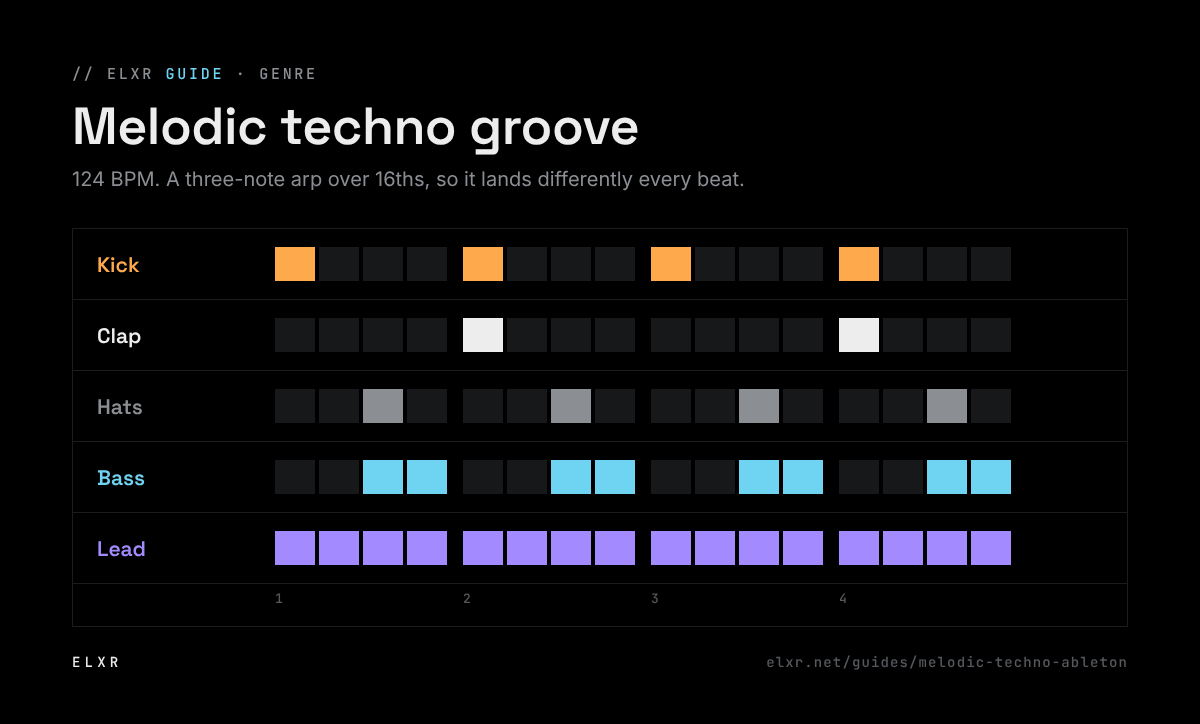
A kick on every beat, a clap on 2 and 4, off-beat hats and a bass that rolls in 16ths around the kick. On top, an arp that repeats three notes over a grid of four, so it lands on a different note every beat. Press play and listen to how the lead seems to turn over itself.
Kick and clap are real ELXR one-shots; hats, bass and lead are simple synths made in your browser. Tap a step to change the pattern, tap a name to mute it.
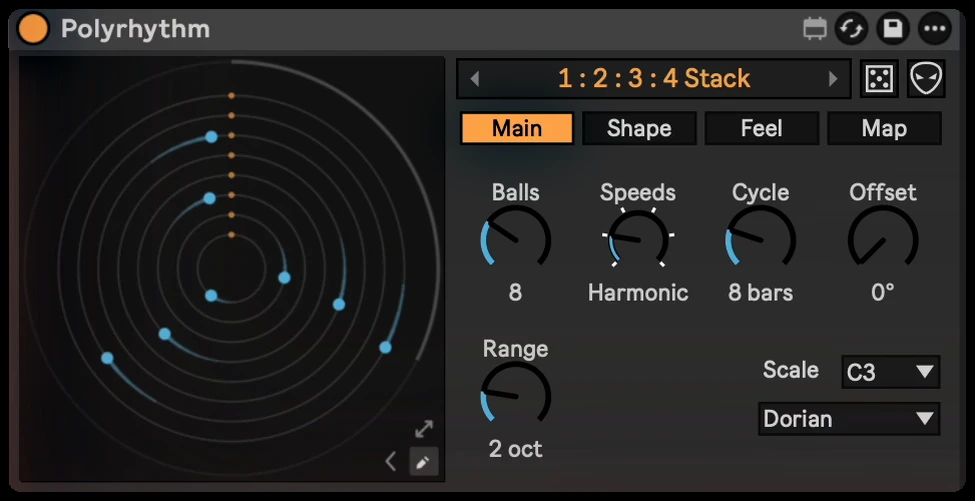
Build shifting patterns like this as shapes with Polyrhythm →
Tempo, key and sounds
- Tempo: 120 to 126 BPM; 124 is common.
- Key: minor keys, often with one chord held for a long time and the melody moving over it.
- Sounds: warm analog-style basses, plucks and arps, dark pads, and long reverbs and delays. Fewer sounds, each with room.
Arps that evolve
- Odd-length patterns: a 3-note or 5-note pattern over 16th notes cycles against the 4/4 bar, so the phrase keeps shifting. This is a polymeter; see polyrhythm vs polymeter.
- Live's Arpeggiator: hold a chord, set Rate to 1/16 and Style to Up, Down or Random; automate Steps or Distance for change.
- Slow automation: open a filter, lengthen the decay or add delay feedback over 16 to 32 bars. The movement should be felt more than noticed.
- Echo: a dotted-8th delay on the arp fills the gaps with its own rhythm.
Let the arp play longer than you think before changing it. The changes that matter are slow ones; a listener should notice the track has moved without knowing when.
Arrangement and mix
- Change something every 8 or 16 bars: add or remove a layer, open a filter, switch the arp pattern.
- Long breakdowns: take out the kick and bass, let the melody and pads carry it, then bring the groove back.
- Space around the kick: sidechain the bass and pads lightly; see where kick and bass overlap with a spectrogram.