 ELXR
How to make uplifting trance in Ableton Live
Uplifting trance runs at about 136 to 140 BPM, in a minor key, with a kick on every beat and the bass on the off-beats. Big minor chord progressions, a wide supersaw lead, gated chords, and a long breakdown that builds into the drop carry the emotion.
The groove
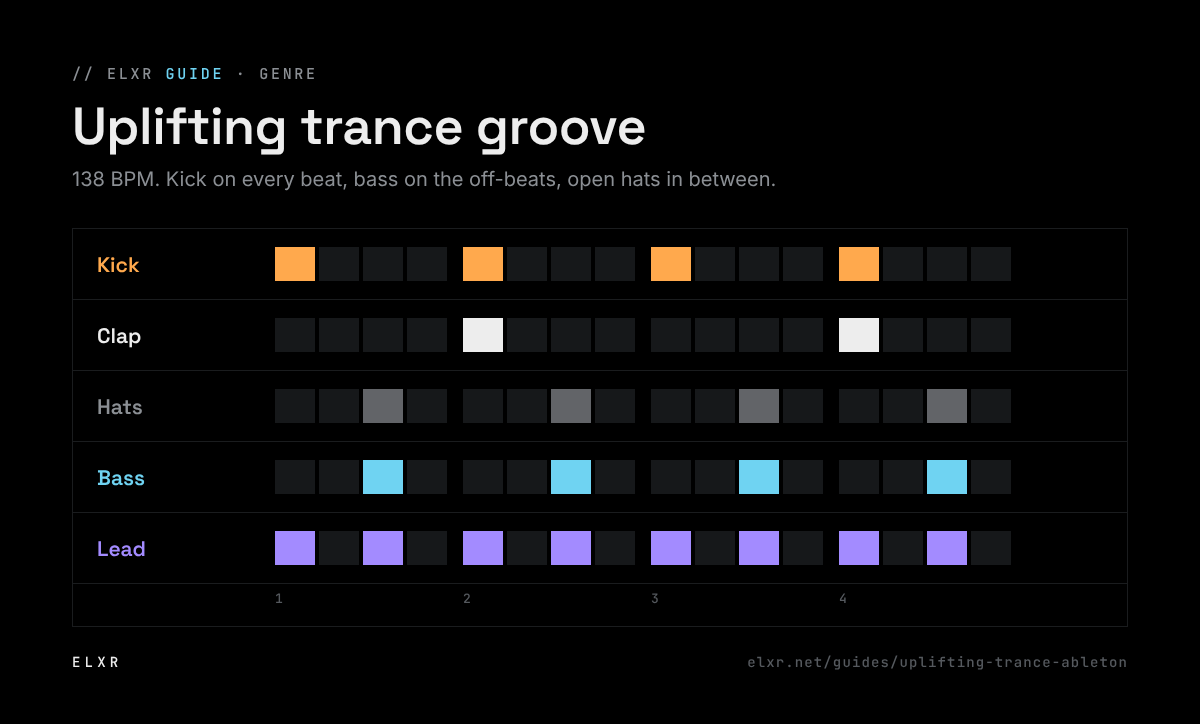
Everything in uplifting trance sits on a simple, driving groove: a kick on every beat, a clap or snare on beats 2 and 4, open hats on the off-beats, and a bass that answers the kick on every off-beat. Press play below and mute the lanes one by one to hear what each part adds.
Kick and clap are real ELXR one-shots; hats, bass and lead are simple synths made in your browser. Tap a step to change the pattern, tap a name to mute it.
Tempo and key
- Tempo: 136 to 140 BPM; 138 is the classic.
- Key: a minor key. The progression i, VI, III, VII (in A minor: Am, F, C, G) is the genre's backbone; try it before anything clever.
- Bass: off-beat 8th notes following the chord roots, or a rolling 16th pattern for more drive. Keep it mono and in tune with the kick.
Chords and the lead
- Supersaw chords: in Wavetable, pick a saw, set Unison to Classic or Shimmer with 6 to 8 voices and raise the amount until it's wide. Play full chords, two octaves apart from the bass.
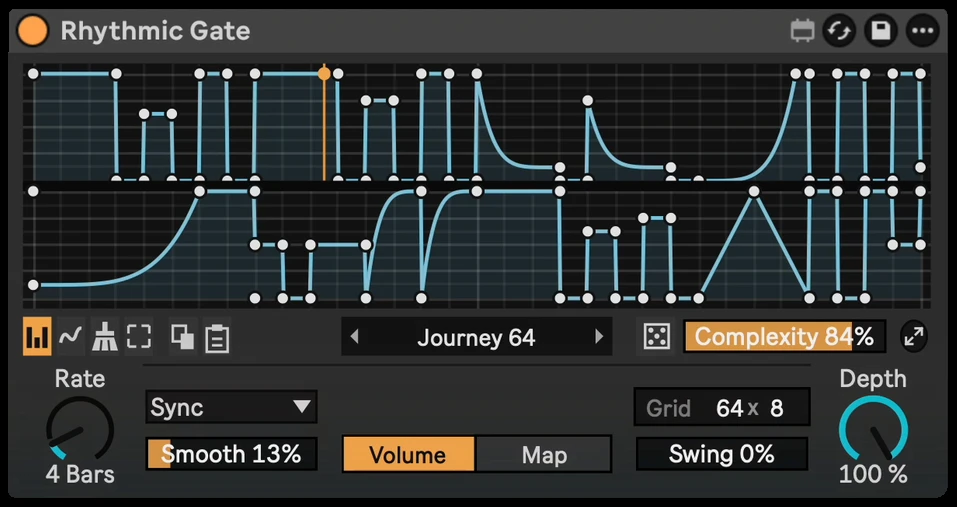
- Gate the chords: a trance gate turns long chords into a rhythmic pulse. See our 8 trance gate patterns.
- The lead: a brighter supersaw or a pluck playing the melody, one octave above the chords. A dotted-8th delay and a long reverb give it the classic size.
- Layer, don't stack: each layer should cover its own range. High-pass the pads and leads so the bass owns the low end.
The breakdown carries it
Uplifting trance is built in 16- and 32-bar sections: a DJ-friendly intro with drums, the main section, a long breakdown, the build and the drop. The breakdown is where the track lives. Drop the kick, let the chords and the melody play on their own, then build back with a riser, a snare roll and a filter opening (see how to make a riser). The drop brings everything back at once.
The breakdown is a promise the drop has to keep. Strip it back further than feels safe; the more space the melody has, the bigger it feels when the kick returns.
Mixing it so it lifts
- Duck everything around the kick: bass, chords and pads dip on each kick, so the groove breathes. See sidechain compression.
- Keep the low end mono and check the whole track in mono: wide supersaws can thin out. See mono compatibility.
- Leave headroom before mastering; the leads get harsh first when a mix is pushed too hot.